Basics of machine learning models in R, focusing on regression and classification models.
Using R packages such as caret or tidymodels for training simple models.
Hands-on exercises to build a basic predictive model, evaluate its performance, and interpret the results.
9.0.2 Outcome
Participants will understand the fundamentals of machine learning models and build their own in R.
9.1 Introduction to Machine Learning Models
Machine learning involves using algorithms to identify patterns within data. In R, packages like caret and tidymodels simplify the process of training and evaluating machine learning models.
9.1.1 Example: Linear Regression with caret
Show the code
# install.packages("caret")library(caret)# Load datasetdata(mtcars)# Split data into training and testing setsset.seed(123)trainIndex <-createDataPartition(mtcars$mpg, p = .8, list =FALSE, times =1)trainData <- mtcars[ trainIndex,]testData <- mtcars[-trainIndex,]# Train a linear regression modelmodel <-train(mpg ~ ., data = trainData, method ="lm")# Summary of the modelsummary(model)
Call:
lm(formula = .outcome ~ ., data = dat)

Residuals:
    Min      1Q  Median      3Q     Max
-3.2742 -1.3609 -0.2707  1.1921  4.9877

Coefficients:
            Estimate Std. Error t value Pr(>|t|)
(Intercept) -2.81069   22.93545  -0.123    0.904
cyl          0.75593    1.21576   0.622    0.542
disp         0.01172    0.01674   0.700    0.494
hp          -0.01386    0.02197  -0.631    0.536
drat         2.24007    1.77251   1.264    0.223
wt          -2.73273    1.87954  -1.454    0.164
qsec         0.53957    0.71812   0.751    0.463
vs           1.21640    2.02623   0.600    0.556
am           1.73662    2.08358   0.833    0.416
gear         2.95127    1.88459   1.566    0.136
carb        -1.19910    0.98232  -1.221    0.239

Residual standard error: 2.431 on 17 degrees of freedom
Multiple R-squared:  0.8861,    Adjusted R-squared:  0.8191
F-statistic: 13.23 on 10 and 17 DF,  p-value: 3.719e-06
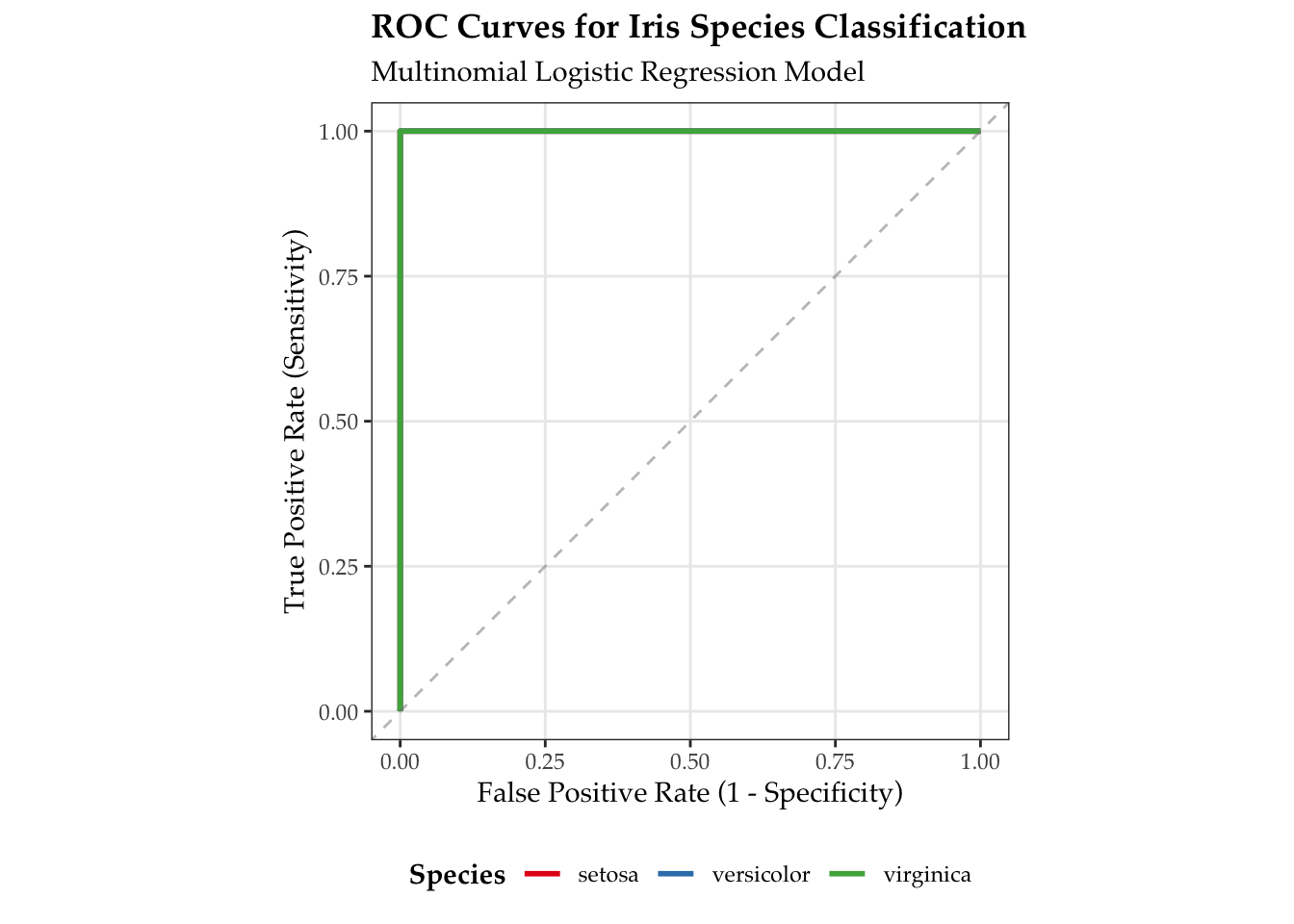
9.1.2 Example: Classification with tidymodels
Show the code
library(tidymodels)library(ggplot2)# Split the dataset.seed(123)iris_split <-initial_split(iris, prop =0.8)iris_train <-training(iris_split)iris_test <-testing(iris_split)# Fit modelmulti_log_reg_model <-multinom_reg() %>%set_engine("nnet") %>%fit(Species ~ ., data = iris_train)# Generate predictions with proper formatpredictions <-predict(multi_log_reg_model, iris_test, type ="prob") %>%bind_cols(iris_test %>%select(Species))# Calculate ROC curve dataroc_data <-roc_curve( predictions,truth = Species, .pred_setosa, .pred_versicolor, .pred_virginica)# Plot the ROC curvesroc_plot <-ggplot(roc_data, aes(x =1- specificity, y = sensitivity, color = .level)) +geom_path(linewidth =1) +geom_abline(lty =2, alpha =0.5, color ="gray50", slope =1, intercept =0) +coord_equal() +labs(title ="ROC Curves for Iris Species Classification",subtitle =paste("Multinomial Logistic Regression Model"),x ="False Positive Rate (1 - Specificity)",y ="True Positive Rate (Sensitivity)",color ="Species" ) +scale_color_brewer(palette ="Set1") +theme_bw() +theme(text =element_text(family ="Palatino"),legend.position ="bottom",panel.grid.minor =element_blank(),plot.title =element_text(face ="bold"),legend.title =element_text(face ="bold") )# Calculate and add the AUC values to the plotauc_values <-roc_auc( predictions,truth = Species, .pred_setosa, .pred_versicolor, .pred_virginica)# Print AUC values and display the plotprint(auc_values)
By following these examples and exercises, participants will gain practical experience in building and evaluating machine learning models using R. This session will enhance their ability to apply predictive modeling techniques to real-world datasets. ```
9.3.1 Recap
Machine Learning Basics: Introduces regression and classification models using caret and tidymodels.
Examples: Provides code snippets for training linear regression and logistic regression models.
Exercises: Offers hands-on practice for building and evaluating predictive models.
References: Lists useful resources for further reading and exploration of machine learning concepts in R.
This chapter ensures participants understand both theoretical concepts and practical applications of machine learning in R.
Source Code
# Chapter 8: Introduction to Machine Learning Models in R### Key Topics- Basics of machine learning models in R, focusing on regression and classification models.- Using R packages such as `caret` or `tidymodels` for training simple models.- Hands-on exercises to build a basic predictive model, evaluate its performance, and interpret the results.### OutcomeParticipants will understand the fundamentals of machine learning models and build their own in R.## Introduction to Machine Learning ModelsMachine learning involves using algorithms to identify patterns within data. In R, packages like `caret` and `tidymodels` simplify the process of training and evaluating machine learning models.### Example: Linear Regression with caret```{r}#| message: false#| warning: false# install.packages("caret")library(caret)# Load datasetdata(mtcars)# Split data into training and testing setsset.seed(123)trainIndex <-createDataPartition(mtcars$mpg, p = .8, list =FALSE, times =1)trainData <- mtcars[ trainIndex,]testData <- mtcars[-trainIndex,]# Train a linear regression modelmodel <-train(mpg ~ ., data = trainData, method ="lm")# Summary of the modelsummary(model)```### Example: Classification with tidymodels```{r}#| message: false#| warning: falselibrary(tidymodels)library(ggplot2)# Split the dataset.seed(123)iris_split <-initial_split(iris, prop =0.8)iris_train <-training(iris_split)iris_test <-testing(iris_split)# Fit modelmulti_log_reg_model <-multinom_reg() %>%set_engine("nnet") %>%fit(Species ~ ., data = iris_train)# Generate predictions with proper formatpredictions <-predict(multi_log_reg_model, iris_test, type ="prob") %>%bind_cols(iris_test %>%select(Species))# Calculate ROC curve dataroc_data <-roc_curve( predictions,truth = Species, .pred_setosa, .pred_versicolor, .pred_virginica)# Plot the ROC curvesroc_plot <-ggplot(roc_data, aes(x =1- specificity, y = sensitivity, color = .level)) +geom_path(linewidth =1) +geom_abline(lty =2, alpha =0.5, color ="gray50", slope =1, intercept =0) +coord_equal() +labs(title ="ROC Curves for Iris Species Classification",subtitle =paste("Multinomial Logistic Regression Model"),x ="False Positive Rate (1 - Specificity)",y ="True Positive Rate (Sensitivity)",color ="Species" ) +scale_color_brewer(palette ="Set1") +theme_bw() +theme(text =element_text(family ="Palatino"),legend.position ="bottom",panel.grid.minor =element_blank(),plot.title =element_text(face ="bold"),legend.title =element_text(face ="bold") )# Calculate and add the AUC values to the plotauc_values <-roc_auc( predictions,truth = Species, .pred_setosa, .pred_versicolor, .pred_virginica)# Print AUC values and display the plotprint(auc_values)print(roc_plot)```## Hands-On Exercise### Exercise 1: Build a Predictive Model1. Use the `mtcars` dataset.2. Train a linear regression model to predict `mpg` using `caret`.```{r eval=F}# Example code structure for building a predictive modelmodel_mtcars <- train(mpg ~ ., data = trainData, method = "lm")summary(model_mtcars)```### Exercise 2: Evaluate Model Performance1. Evaluate the model on test data.2. Interpret the results and discuss potential improvements.```{r eval=F}# Predict on test datapredictions_mtcars <- predict(model_mtcars, newdata = testData)# Calculate RMSErmse(predictions_mtcars, testData$mpg)```## References- Kuhn, M., & Johnson, K. (2013). *Applied Predictive Modeling*. Springer.- Wickham, H., & Grolemund, G. (2016). *R for Data Science*. O'Reilly Media.- Max Kuhn's [caret package documentation](https://topepo.github.io/caret/index.html).- [Tidymodels website](https://www.tidymodels.org/) for comprehensive guides and tutorials.By following these examples and exercises, participants will gain practical experience in building and evaluating machine learning models using R. This session will enhance their ability to apply predictive modeling techniques to real-world datasets. \`\`\`### Recap- **Machine Learning Basics:** Introduces regression and classification models using `caret` and `tidymodels`.- **Examples:** Provides code snippets for training linear regression and logistic regression models.- **Exercises:** Offers hands-on practice for building and evaluating predictive models.- **References:** Lists useful resources for further reading and exploration of machine learning concepts in R.This chapter ensures participants understand both theoretical concepts and practical applications of machine learning in R.